How Much Does Septic Tank Installation Cost in Ocala?
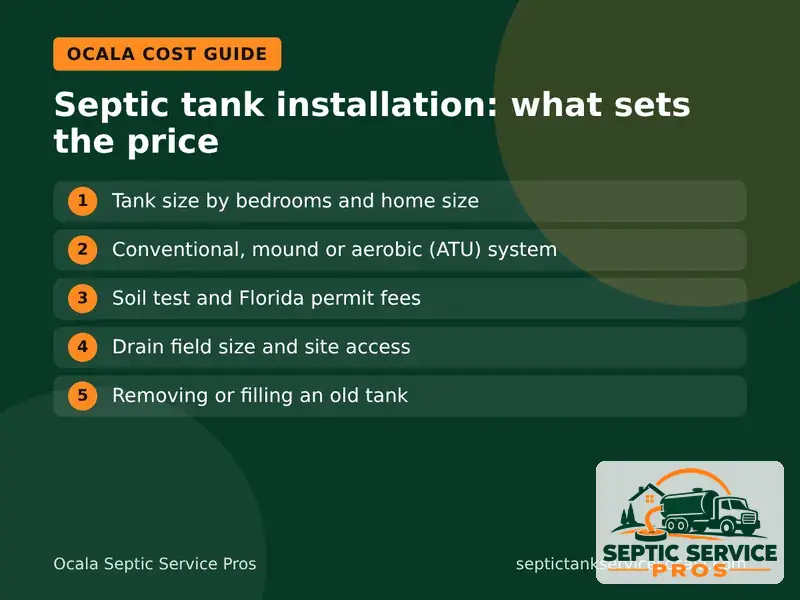
Building on a lot without sewer or replacing a failed system? Here is what a new septic system costs in Marion County and why.
Read the guide ›Wait too long and grease clogs your kitchen lines. Pump too often and you waste money. Here is how Ocala kitchens set the right schedule.
Call Now – (352) 677-6144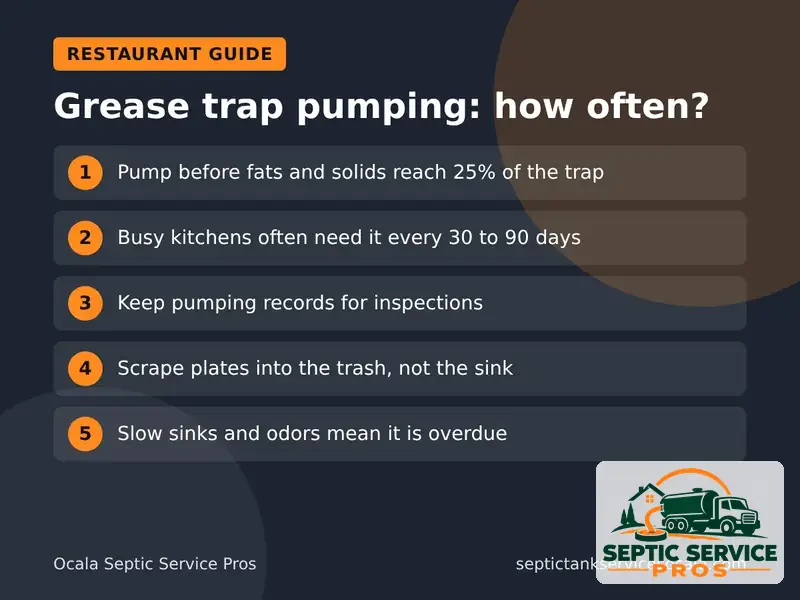
Most restaurant grease traps need pumping when fats, oils, grease and food solids fill about a quarter of the trap's depth, a common rule many utilities use. For small indoor traps, that is often every few weeks to every month. Large outdoor interceptors often go one to three months. Small indoor traps cost about $150 to $350 per service, and outdoor interceptors about $350 to $900. Call (352) 677-6144.
Our grease trap pumping in Ocala crews service cafes, restaurants, schools and food trucks across Marion County, with a disposal record after every visit.
The 25 percent rule says a grease trap should be pumped before grease and solids take up about 25 percent of its liquid depth. Past that point, the trap stops slowing water down enough for grease to separate, and grease starts flowing into the sewer or septic line. Many local utilities use this rule, so check your permit for the exact limit.
A tech can measure the grease and solid layers with a sludge judge at each visit. After a few visits, you will know how fast your kitchen fills the trap and can set a steady schedule.
The schedule depends on trap size, how many meals you serve and what you cook. Fryers, grills and dish-heavy kitchens fill traps fastest. Here are common starting points, adjusted after the first few measurements.
| Kitchen type | Trap type | Common starting schedule |
|---|---|---|
| Coffee shop or small cafe | Small indoor trap | Every 4 to 8 weeks |
| Busy restaurant with fryers | Small indoor trap | Every 2 to 4 weeks |
| Full-service restaurant | Outdoor interceptor | Every 1 to 3 months |
| School or institutional kitchen | Outdoor interceptor | Every 1 to 3 months, more during the school year |
Slow sinks, a bad smell in the kitchen, grease in the floor drains, and backups during the dinner rush are the main signs. If you see any of these, book a pump-out now instead of waiting for the next date.
A full service includes pumping out all grease, solids and water, scraping the walls and baffles, checking the inlet and outlet, checking the lid and gasket, and giving you a written disposal record. Keep each record on file for inspections.
If lines are clogged with grease, line jetting runs about $250 to $600. Baffle or lid repairs run about $200 to $800.
Price depends on trap size and how full it is. Here are typical Ocala ranges.
| Service | Best for | Typical cost |
|---|---|---|
| Indoor trap pumping (under 100 gal) | Cafes, small restaurants | $150–$350 |
| Outdoor interceptor (500–1,500 gal) | Full-service restaurants | $350–$900 |
| Line jetting | Grease buildup in kitchen lines | $250–$600 |
| Baffle or lid repair | Damaged trap parts | $200–$800 |
Regular service often costs less per visit than an emergency call, because the trap is easier to clean when it is not packed.
Is your business on septic instead of sewer? Grease can also ruin a drain field. See our septic tank service Ocala FL page, or drain field repair Ocala if the field is already soggy.
Call (352) 677-6144. We will measure your trap on the first visit and suggest a pump schedule that fits your kitchen.
Often every 2 to 8 weeks for small indoor traps and every 1 to 3 months for outdoor interceptors. The 25 percent rule and your permit set the exact schedule.
Pump the trap before grease and solids fill about 25 percent of its liquid depth. Many utilities use this rule.
Small indoor traps cost about $150 to $350 per service. Outdoor interceptors cost about $350 to $900.
Yes. Keep the written disposal record from each visit on file for inspections.
Septic problem right now? We answer 24/7 in Ocala.
More on this topic: grease trap pumping in Ocala.
Building on a lot without sewer or replacing a failed system? Here is what a new septic system costs in Marion County and why.
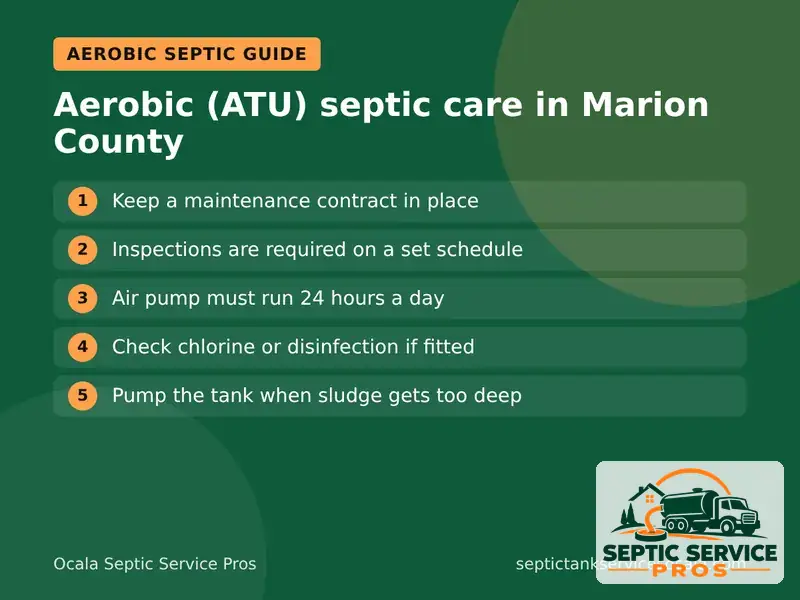
Read the guide ›An aerobic system cleans wastewater better than a plain tank, but only if the air pump, alarm and filters keep working. Here is the checklist.
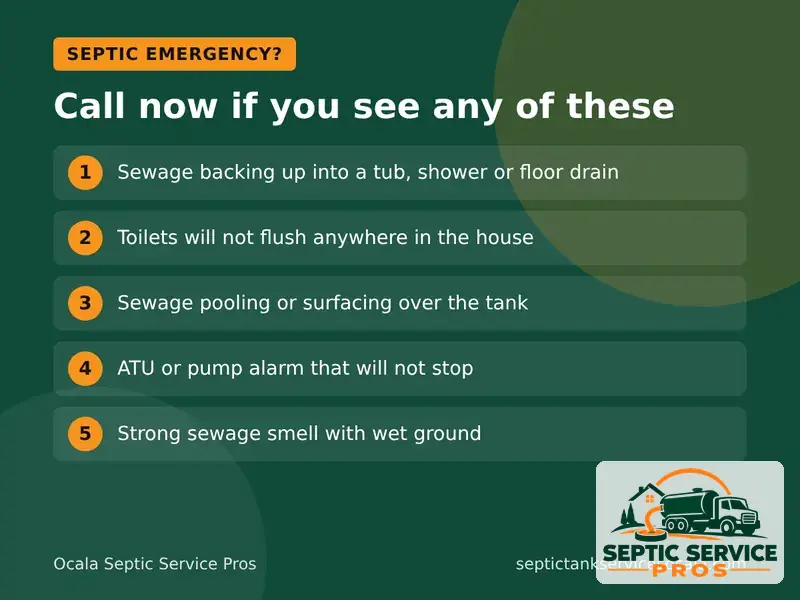
Read the guide ›Sewage in the tub at 11 p.m. is an emergency. A slow sink usually is not. Here is how to tell, and what to do before the truck arrives.
Read the guide ›Call (352) 677-6144 any time for a price and the next open truck.
(352) 677-6144 Call Now – (352) 677-6144